
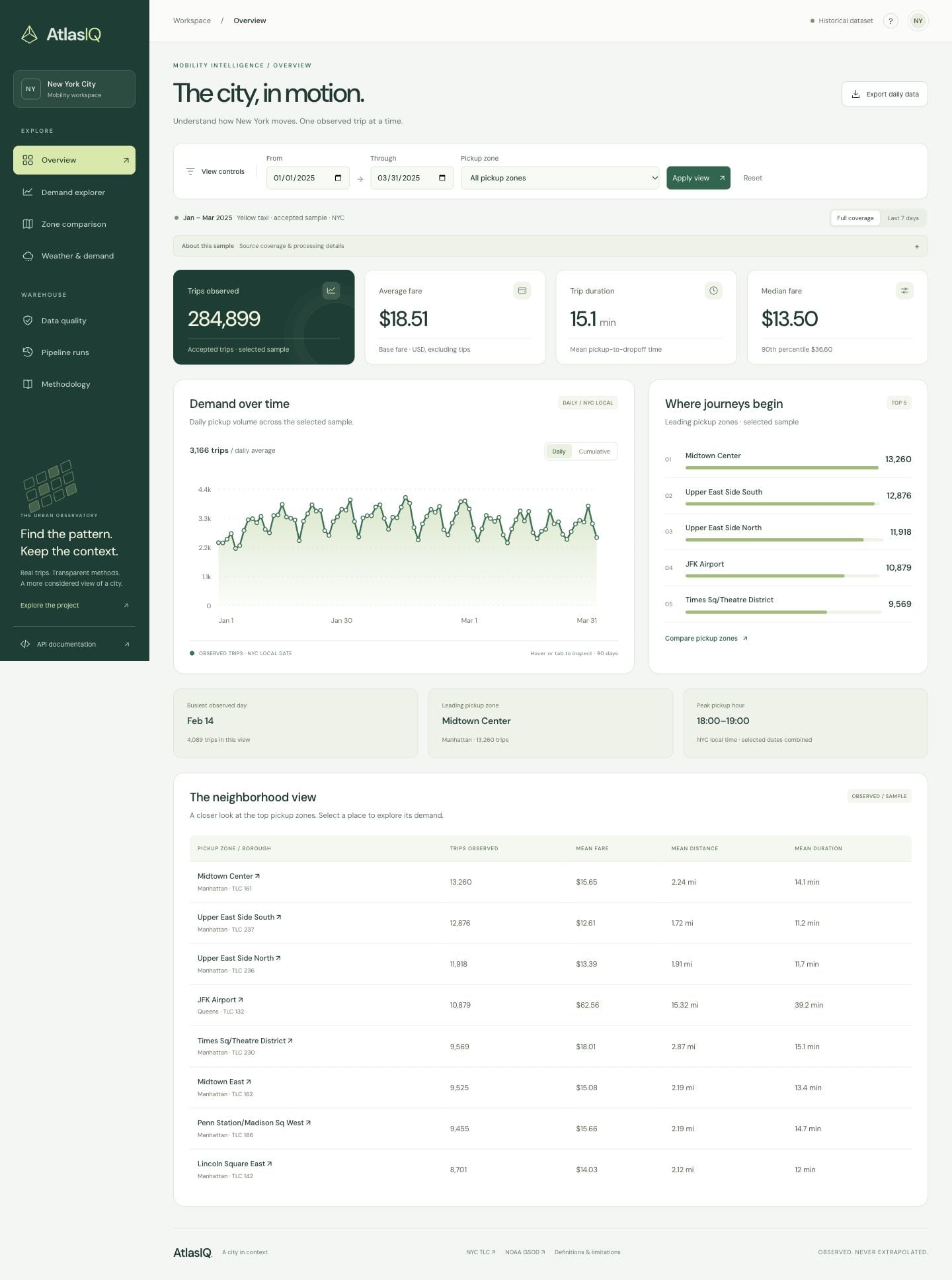
Large, imperfect source files need reproducible sampling and trustworthy publication.
01 / Problem & data
Can someone inspect a demand chart and determine which source records were accepted, rejected, and published?
Official NYC TLC Yellow taxi records, a zone lookup, and NOAA daily weather. The recorded runs use deterministic, bounded monthly samples; their counts are not expanded to city-wide totals.
My contribution
Validation, rejected-row review, warehouse models, and an analytical interface.
02 / Implementation
Follow the data through the product.
Data path / step 01
TLC + NOAA sources
TLC trip records, zone lookups, and NOAA weather provide the bounded analytical sources.
FromSource recordsToChecksums + validation
Data path / step 02
Checksums + validation
Checksums identify source files. Validation separates accepted rows from explained rejections.
FromTLC + NOAA sourcesToPostgreSQL partitions
Data path / step 03
PostgreSQL partitions
Monthly partitions support replacement and replay without accumulating duplicate trips.
FromChecksums + validationTodbt quality gate
Data path / step 04
dbt quality gate
Warehouse transformations and quality checks finish before the data is published for analysis.
FromPostgreSQL partitionsToTyped API + dashboard
Data path / step 05
Typed API + dashboard
Typed API responses connect the analytical views to demand, zones, and data-quality information.
Fromdbt quality gateToAnalytical interface
Three implementation choices
Make rejection part of the product.
Invalid rows are quarantined with reasons instead of silently disappearing. Data quality and load history are available alongside demand and zone comparisons.
Replace revised partitions atomically.
Monthly partition replacement and payload fingerprints avoid accumulating duplicate records on replay. A failed replacement rolls back rather than leaving a partial month.
Publish only checked transformations.
The analytical API waits for warehouse transformations and quality checks. This keeps newly loaded raw data from appearing as if it were ready for analysis.
03 / Evidence & reflection
What the work demonstrates.
The recorded three-month backfill selected 300,000 records: 284,899 accepted trips and 15,101 rejections. Replaying February preserved the counts and trip fingerprints. This demonstrates bounded local replay, not full-month production throughput.
Next iteration
Test backup restoration and larger loads, and explore a versioned serving swap to improve availability during warehouse publication.