
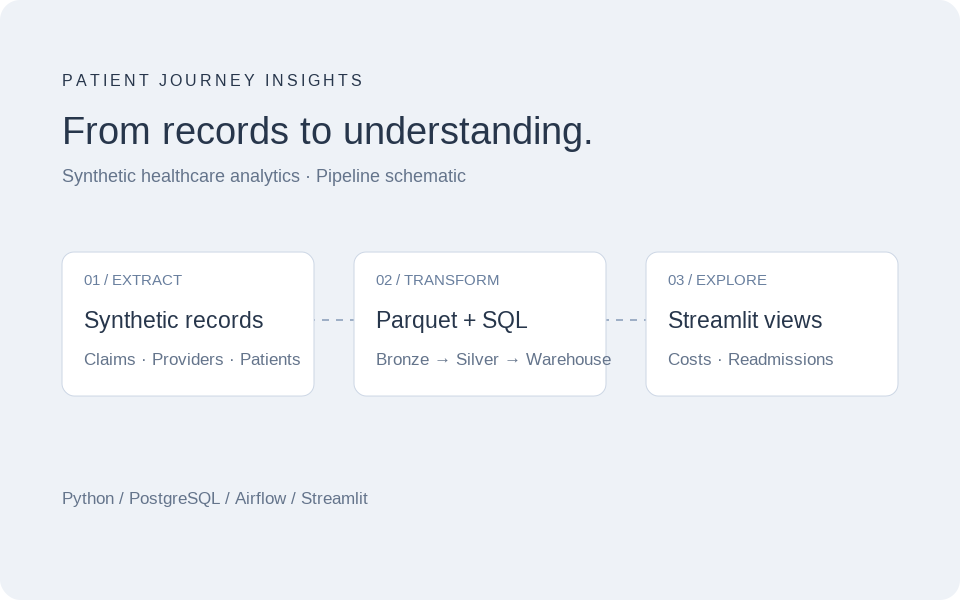
How do source records become usable cost and readmission views?
01 / Problem & data
What needs to happen between raw synthetic records and a dashboard that can explain costs and readmissions?
The default extraction path generates demonstration records. These are synthetic examples, not a hospital EHR connection or evidence of clinical outcomes.
My contribution
Extraction, transformation, SQL, orchestration definitions, and a dashboard.
02 / Implementation
Follow the data through the product.
Data path / step 01
Synthetic records
Demonstration records are synthetic. This path does not connect to a hospital EHR.
FromSource recordsToBronze Parquet
Data path / step 02
Bronze Parquet
Bronze Parquet retains an inspectable output from extraction.
FromSynthetic recordsToCleaned silver layer
Data path / step 03
Cleaned silver layer
The silver layer separates cleaning and derived fields from the source records.
FromBronze ParquetToPostgreSQL + SQL
Data path / step 04
PostgreSQL + SQL
SQL and warehouse-loading modules form a separate path that still needs integration work.
FromCleaned silver layerToStreamlit analysis
Data path / step 05
Streamlit analysis
The file-based Streamlit dashboard can be reviewed independently of the warehouse path.
FromPostgreSQL + SQLToAnalytical interface
Three implementation choices
Keep intermediate layers inspectable.
Bronze and silver Parquet outputs separate extraction from cleaning, making it easier to inspect derived fields before warehouse loading.
Give the dashboard a file-based path.
The Streamlit interface can read checked-in silver-layer files when PostgreSQL is unavailable. That makes the visual analysis reviewable independently of the full stack.
Separate interface readiness from pipeline readiness.
A working file-based dashboard is not proof of a completed warehouse load. The loader’s schema selection still needs integration work, so the case study keeps those claims separate.
03 / Evidence & reflection
What the work demonstrates.
The project includes extraction and transformation modules, analytical SQL, dashboard views, and an Airflow definition. A fresh full-stack execution has not been established, so no operational improvement metric is presented.
Next iteration
Resolve the warehouse schema mismatch, verify a clean install, and run the pipeline end to end. Source code remains private; this page summarizes the project’s scope.