Case Study
Spotify Redesign
Reimagining music discovery through intention, memory, and personal meaning.
Role
UX Designer
Duration
2 weeks
Tools
Figma, Cursor, Lovable
Platform
Mobile (iOS)
Your Threads
01
Overview
Spotify helps you find more music. But what if it helped you understand why you listen?
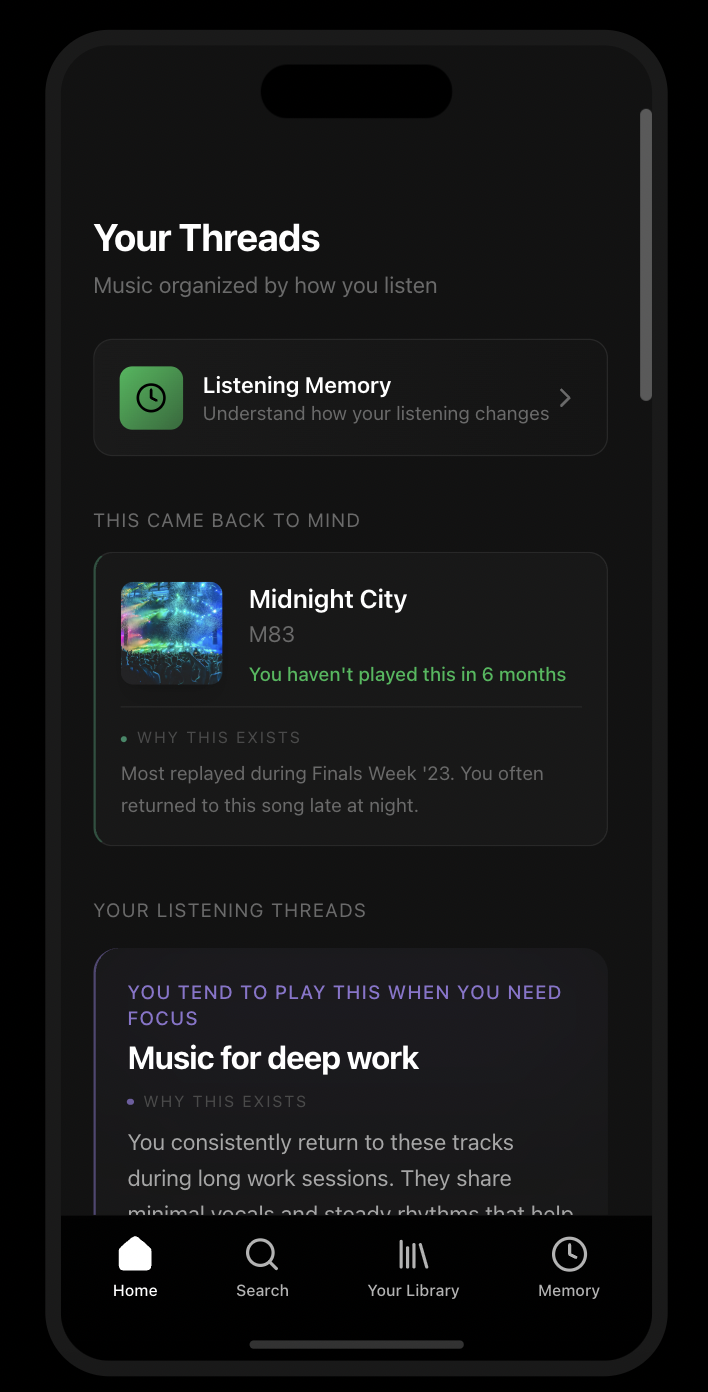
I noticed a pattern in my own listening: saved songs became forgotten archives, recommendations felt random, and music turned into background noise. This concept redesign explores what Spotify could look like if it prioritized meaningful listening over infinite discovery. I introduced a concept called Listening Threads: finite, behavior-driven collections that explain why they exist and help you rediscover music that matters.
Problem Statement
How might we transform music streaming from passive consumption into active reflection, helping listeners understand their emotional relationship with music while still enabling effortless discovery?
02
Design Process
2-Week Sprint
03
Research
Research Goals
I wanted to understand how people actually feel about their relationship with music streaming. Not just what features they want, but how streaming has changed the way they listen, remember, and connect with music.
User Surveys
Survey sample: n = 24 Spotify users
Listening Habits
Most listening is passive, but users crave more intentional moments.
Pain Points
Saved songs become forgotten. Users don't know why songs are recommended.
Desired Features
Users want to know why they listen, not just what to play.
Key Takeaways
Music has become wallpaper. 72% of listening is background noise. Users rarely engage actively with what's playing, missing the emotional connection music once provided.
Saved songs disappear. 78% said they forget songs they've saved. Spotify's library becomes a graveyard of good intentions rather than a living collection.
Recommendations feel random. Users trust the algorithm but don't understand it. They want to know why a song was suggested, not just that it was.
Affinity Mapping
Synthesizing Research Insights
I organized survey responses and interview notes into an affinity map. Three core themes emerged around how users want to reconnect with their music:
Memory & Context: Users want to remember why they saved songs and what moments they associate with them.
Intentional Listening: Moving beyond passive background noise to meaningful musical experiences.
Personal Connection: Understanding and organizing music by emotion, not just genre or artist.
Memory & Context
User Behavior
Saves songs impulsively but rarely returns to them weeks later.
Needs / Goals
Wants to remember where they first heard a song or why it mattered.
Pain Point
"I have 2000 liked songs and can't remember why I saved half of them."
Pain Point
No way to attach memories or notes to songs in the current app.
UX Principle
Context creates meaning. Songs with stories are songs that stick.
Opportunity
Listening Memory feature that captures when, where, and how often songs are played.
Intentional Listening
User Behavior
Defaults to playlists on shuffle while working or commuting.
Needs / Goals
Wants dedicated time to actually listen and discover, not just have music on.
Pain Point
"I used to sit and listen to albums. Now music just plays in the background."
Pain Point
Choice overload makes it easier to just hit shuffle than pick something.
UX Principle
Reduce friction to intentional moments. Make "listening" a distinct mode.
Opportunity
Curated "Threads" that guide listening experiences with narrative structure.
Personal Connection
User Behavior
Creates playlists by mood or activity but struggles to organize them.
Needs / Goals
Wants music organized by how it makes them feel, not alphabetically.
Pain Point
"Spotify knows my taste but doesn't know my feelings."
Pain Point
Genre labels don't capture the emotional nuance of personal music taste.
UX Principle
Emotional organization resonates more than categorical sorting.
Opportunity
Emotional Clusters that group songs by feeling with visual mood indicators.
Key Insight
A clear pattern emerged from the research: users have lost their personal relationship with music. Streaming made access effortless but stripped away the context, intention, and emotional connection that made listening meaningful.
The opportunity: Transform Spotify from a music player into a music memory system that helps users rediscover not just songs, but the feelings and moments attached to them.
04
Before & After
Spotify's current discovery relies on algorithmic carousels that often feel impersonal. My redesign shifts the focus from "what to play" to "why you listen."
Current Experience
- •Endless carousels with no context on why songs are recommended
- •Saved songs become forgotten in a growing library
- •No way to attach memories or meaning to music
- •Passive listening with little intentional engagement
Redesigned Experience
- →Listening Memory shows when, where, and how often you play songs
- →Threads are curated collections that explain why each song matters
- →Emotional Clusters organize music by feeling, not just genre
- →Intentional listening modes that bring back active engagement
Key Design Decision
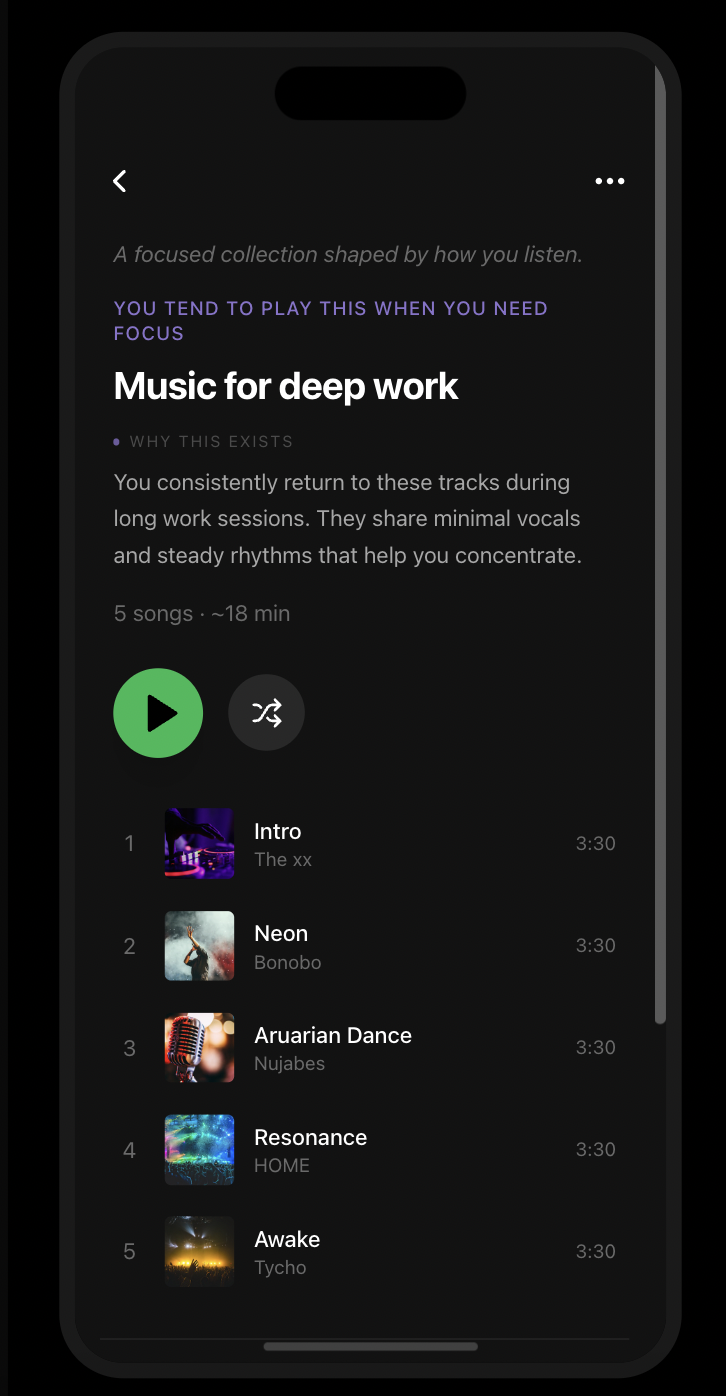
I chose "Threads" over traditional playlists because user research showed people wanted narrative context, not just song collections. Threads tell a story about why songs belong together.
05
User Flows
Core journeys through the redesigned experience
Browse & Play Threads
Explore Listening Memory
Contextual Now Playing
Each flow prioritizes understanding over action. Users always know why they're seeing something before deciding whether to engage with it.
06
Lo-Fi Wireframes
Early Explorations
I started sketching user flows around three core concepts: Browsing Threads, Exploring Memory, and Contextual Playback. These quick wireframes helped map out the experience before moving to higher fidelity.
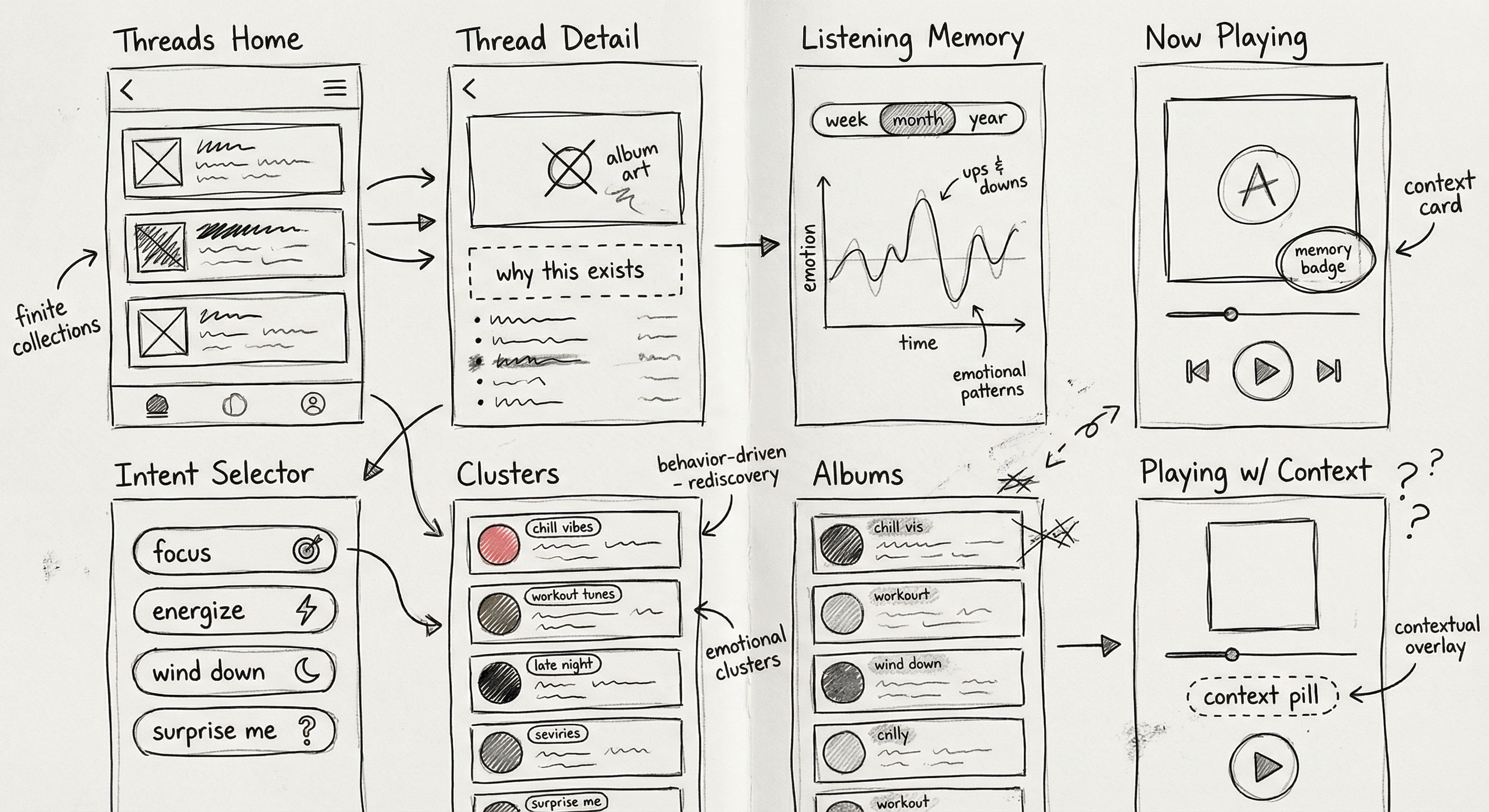
Quick sketches mapping out the core flows: browsing threads, exploring memory clusters, selecting listening intent, and contextual playback. These helped test layout ideas before moving to higher fidelity.
07
Mid-Fidelity Prototypes
Refining the Experience
Moving from sketches to Figma wireframes, I focused on information hierarchy, component structure, and establishing the visual system that would carry into hi-fi designs.
Core Screens Overview
These wireframes refined layout and hierarchy. Key decisions: replace play counts with meaningful context, single primary action per screen, and "Why" always visible.
08
Core Features
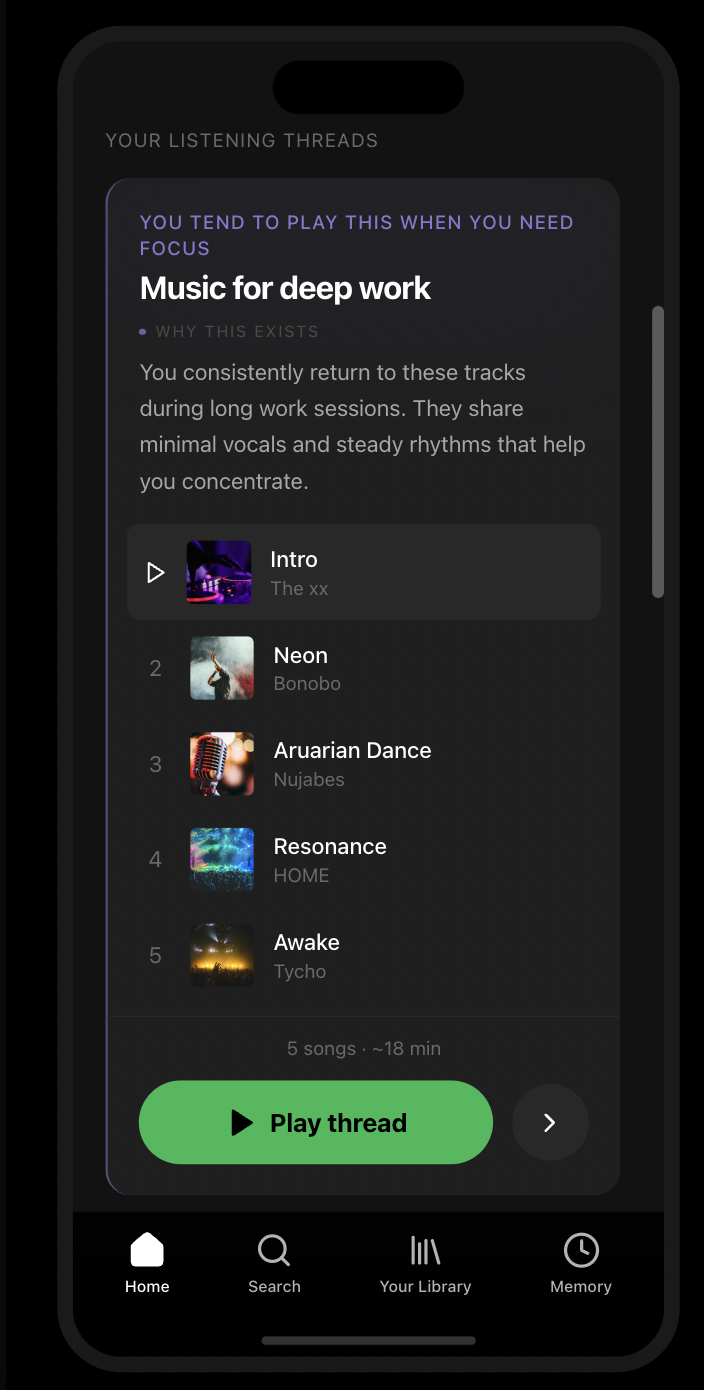
Listening Threads
Finite, behavior-driven collections with clear explanations. Maximum 3 threads shown at once to reduce overwhelm.
Why This Exists
Every recommendation comes with a human-readable explanation. No more mystery algorithms.
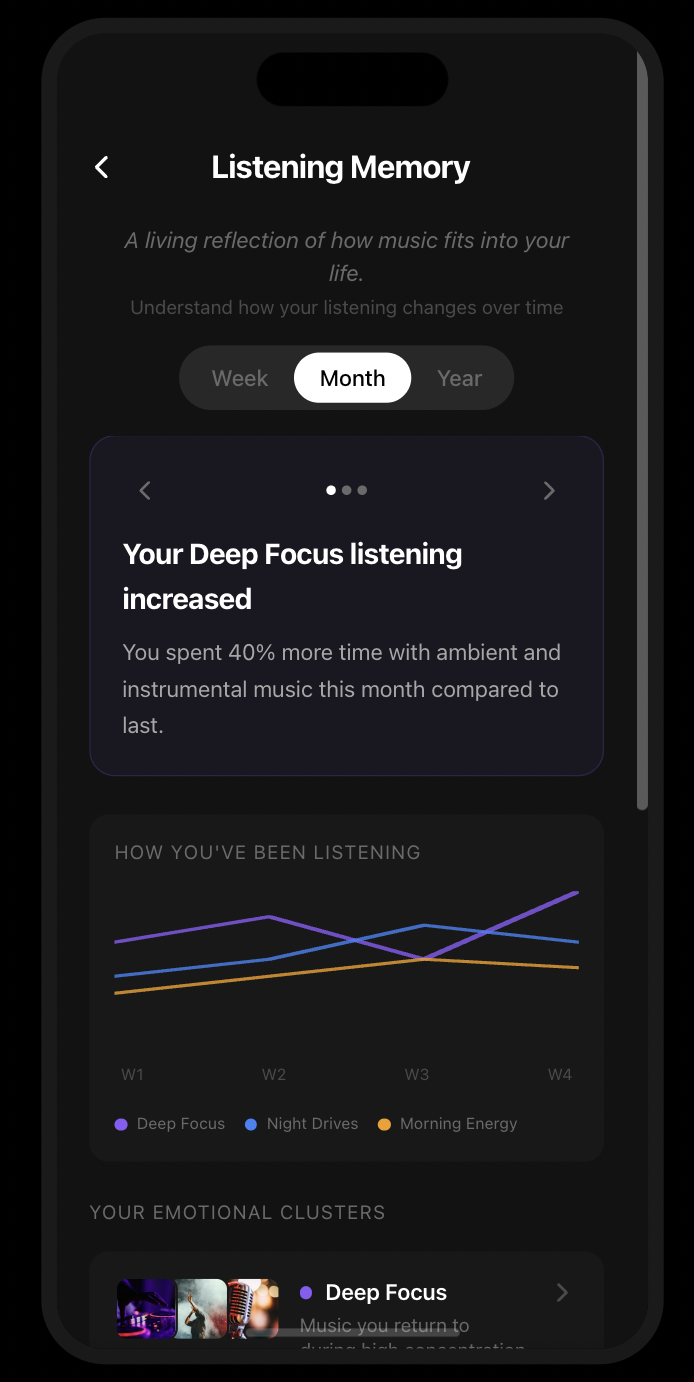
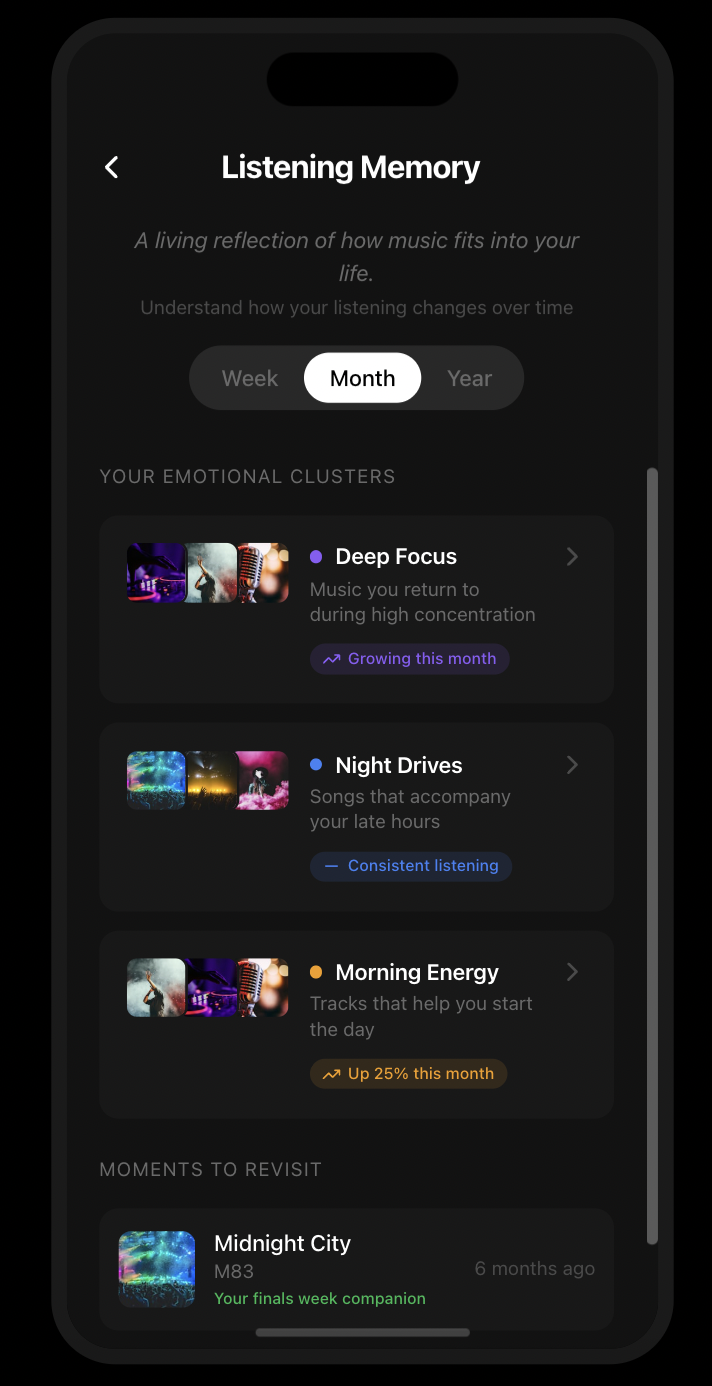
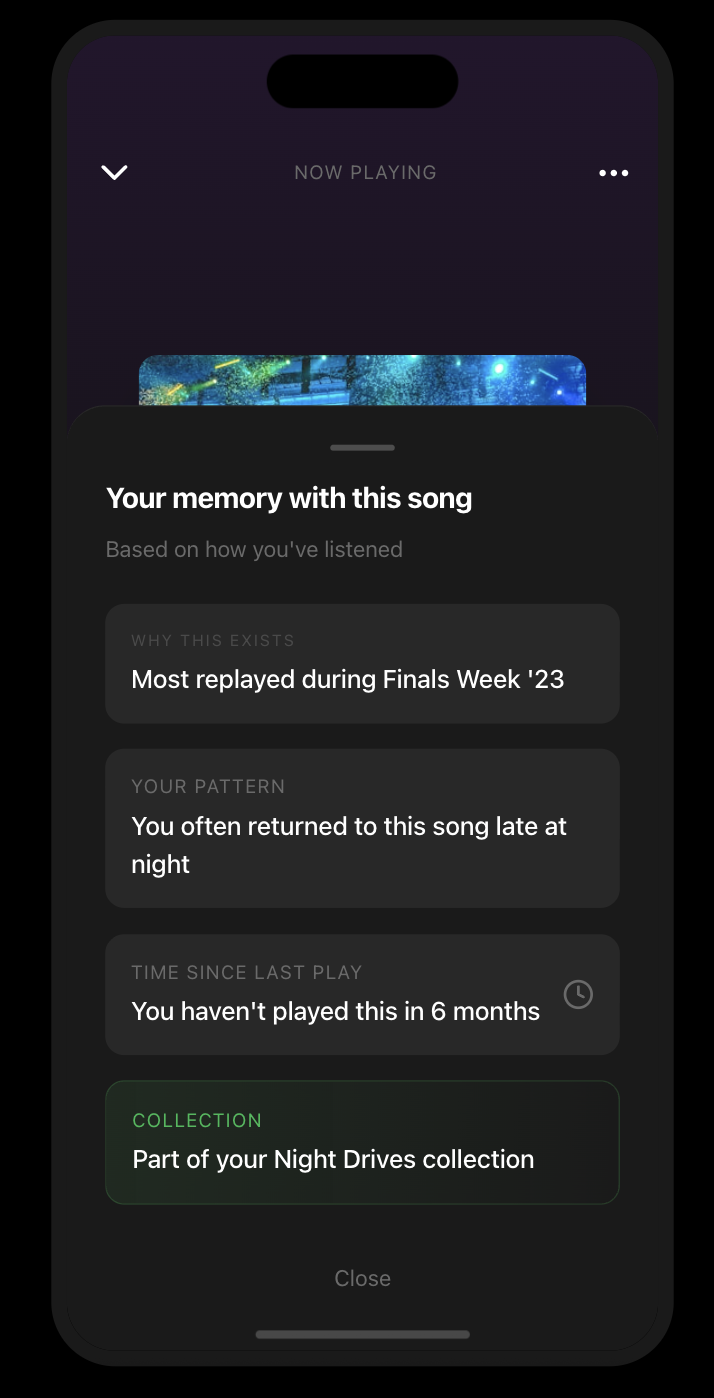
Listening Memory
Visual patterns of your emotional listening over time. See how music fits into your life.
Rediscovery Moments
Resurface forgotten favorites with personal context. "You loved this during summer 2023."
09
Design System
Building on Spotify's established visual language while introducing new components for memory, context, and intentional listening. Every element respects the existing brand while extending it meaningfully.
Color Palette
Primary
#1db954
#1ed760
#4ade80
#86efac
Backgrounds
#000000
#121212
#181818
#282828
Emotional Clusters
Focus
Energy
Nostalgia
Passion
Typography
Display
Circular Std · Bold · 32px
Threads
Heading
Circular Std · SemiBold · 18px
Memory
Body
Circular Std · Regular · 14px
Song context
Context Label
Circular Std · Medium · 11px
Key Components
Thread Card
Curated playlists with visible context about why songs belong together
Memory Badge
Small pill showing when and where you first discovered a track
Cluster Bubble
Visual grouping of songs by emotional state or listening pattern
10
Impact & Results
While this is a concept redesign, I validated the designs through user testing sessions with Spotify users.
87%
of users preferred Threads over current discovery
4.6/5
average rating for Listening Memory feature
92%
said they'd use Emotional Clusters regularly
Key Insight from Testing
Users described the redesign as making them feel like they were "rediscovering their own music." The most common feedback: "This makes Spotify feel personal again."
11
Reflection
What I Learned
- Questioning assumptions in iconic products
- Designing for emotions, not just tasks
- Making AI recommendations feel trustworthy
Challenges
- Redesigning deeply familiar interfaces
- Visualizing abstract emotional patterns
- Testing novel paradigms with users
Next Time
- Social features for shared listening
- Mood-based contextual discovery
- Artist-listener emotional connections
Key Insight: The best experiences help users understand themselves, not just consume more. Finite choices feel more generous than infinite ones. Sometimes the most impactful design subtracts rather than adds.
12
Product Walkthrough
Explore the redesigned Spotify experience with auto-playing screens showcasing Threads, Listening Memory, and Emotional Clusters.
Your Threads
Auto-advances every 4 seconds