
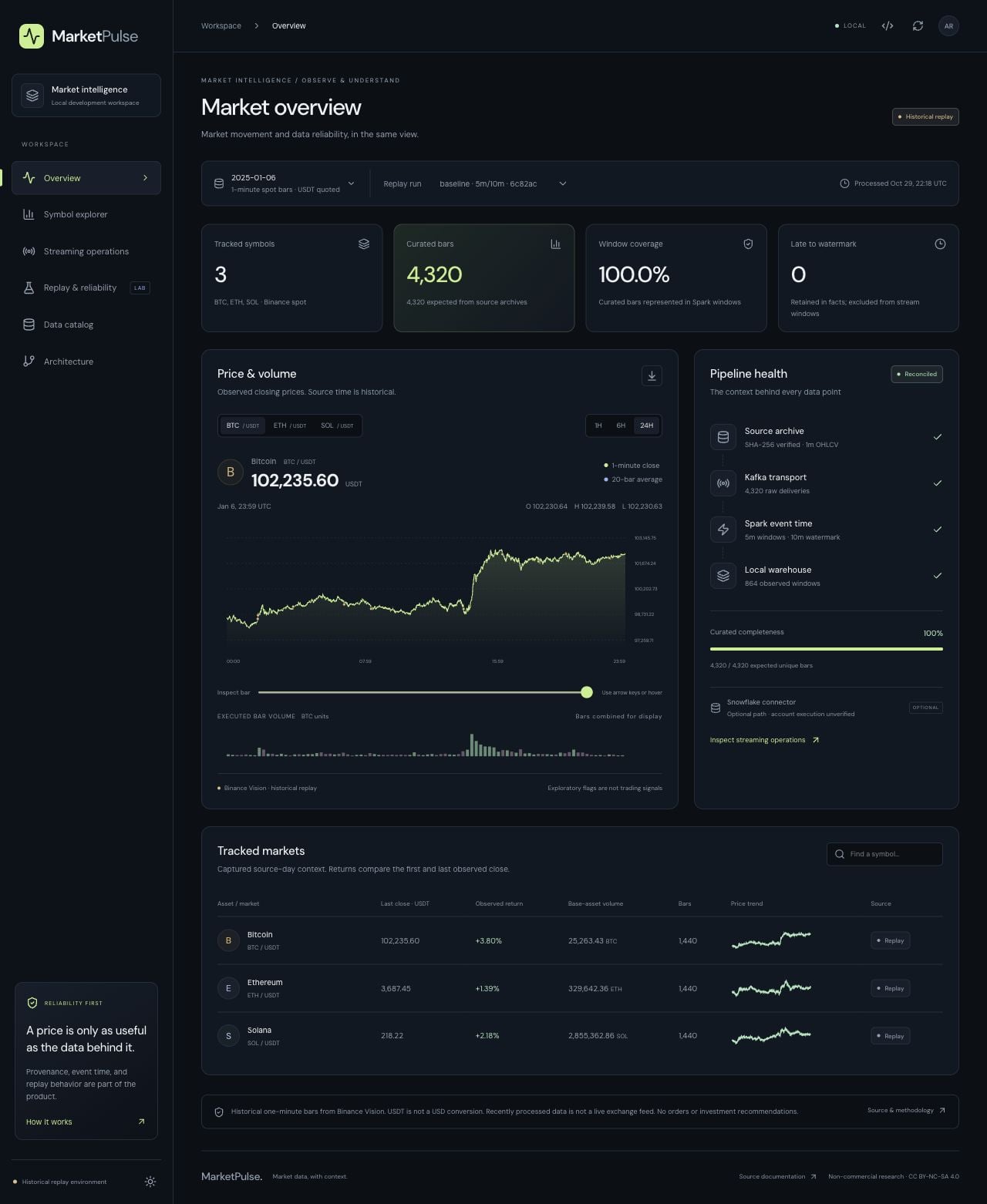
A convincing chart can conceal duplicate delivery, late events, or a failed retry.
01 / Problem & data
Can a reviewer follow the same market event through a normal replay, a duplicate, and a recovery?
Official Binance Vision one-minute spot bars for BTCUSDT, ETHUSDT, and SOLUSDT on January 6, 2025. This is historical replay, with source dates and units visible in the interface.
My contribution
Historical replay, event-time windows, audit records, and a dashboard.
02 / Implementation
Follow the data through the product.
Data path / step 01
Verified source archives
The replay starts with dated Binance Vision archives, not a live market feed.
FromSource recordsToVersioned Python events
Data path / step 02
Versioned Python events
Versioned events give each historical bar a consistent structure before delivery.
FromVerified source archivesToKafka + Spark
Data path / step 03
Kafka + Spark
Kafka delivers events; Spark handles event-time windows and late arrivals.
FromVersioned Python eventsToPostgreSQL facts + audit
Data path / step 04
PostgreSQL facts + audit
Accepted market facts and delivery audit decisions remain separate, so repeats are inspectable.
FromKafka + SparkToFastAPI + Next.js
Data path / step 05
FastAPI + Next.js
The API and dashboard expose the recorded replay and its processing context.
FromPostgreSQL facts + auditToAnalytical interface
Three implementation choices
Separate delivery from market identity.
Every Kafka delivery receives an audit decision. Accepted market facts use a separate identity, so repeated messages can increase delivery counts without inflating market volume.
Keep late facts visible.
A valid late bar can remain in the fact table even when the watermark excludes it from a closed window. Separate audit and window views make that difference inspectable.
Name the recovery boundary.
A transactional batch ledger suppresses repeated warehouse writes after a callback retry. The outbox can still publish again; the system is described as at-least-once rather than end-to-end exactly-once.
03 / Evidence & reflection
What the work demonstrates.
The checked-in verification record covers a 4,320-bar replay and recorded duplicate, late, and restart experiments. Those runs support the local delivery behavior; they do not establish production capacity or trading performance.
Next iteration
Extend recovery testing beyond the demonstrated callback boundary and test realistic state sizes before making scale or availability claims.